Natural Catastrophe Losses Top $100 Billion for 6th Year

January 20, 2026
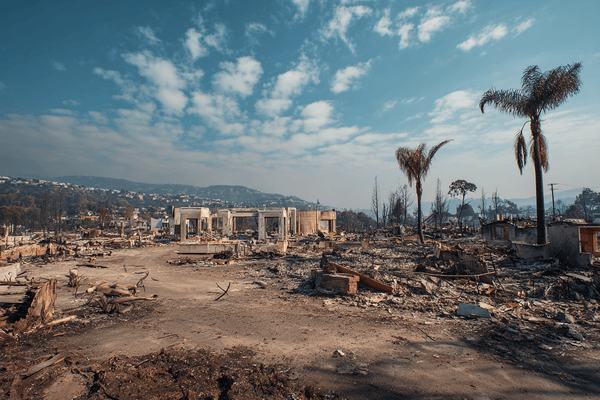
Global insured losses from natural catastrophes are projected to reach $107 billion in 2025, marking the sixth consecutive year that losses have exceeded $100 billion, according to Swiss Re Institute. The figure reflects a 24 percent drop from the $141 billion recorded in 2024, driven primarily by the most expensive wildfire event in global history and continued severe convective storm (SCS) activity, particularly in the United States.
The United States accounted for $89 billion, or 83 percent, of global insured natural catastrophe losses in 2025. The primary driver was the catastrophic wildfires in Los Angeles, which caused $40 billion in insured losses—making it the costliest wildfire event ever. Swiss Re attributed the scale of destruction to a combination of extreme weather conditions and expanding residential development in high-risk wildland–urban interface zones.
SCS activity also remained a significant contributor to losses. Insured damages from these storms totaled $50 billion globally, making 2025 the third costliest year for SCS after 2023 and 2024. Early-year US tornado outbreaks in March and May led to elevated tornado and wind activity, though hail events remained near average. In Europe, hailstorms in May and June were notable, but impacted less densely insured regions.
"We are observing a steady rise in losses from severe convective storms. Urbanization in hazard-prone areas, rising asset values, higher construction costs, and factors such as ageing roofs have made these storms a key peril for insurers. As single events rarely result in a large insured loss, it is key for insurers to consider the cumulative effect of frequent, low-loss events, along with increasing property values and repair costs. A more holistic view of this peril is critical to assure proper underwriting and risk management," Balz Grollimund, head of catastrophe perils at Swiss Re, said.
Hurricane losses were comparatively low in 2025 despite an active Atlantic season. Hurricane Melissa, which made landfall in Jamaica as a Category 5 storm in October with winds nearing 298 kilometers per hour (approximately 185 miles per hour), caused up to $2.5 billion in insured losses. It was the strongest hurricane on record to strike Jamaica and the costliest of the year. The US mainland was spared from landfall, resulting in muted hurricane-related losses.
Severe flooding in Southeast Asia in November, driven by multiple cyclonic systems and intensified monsoon conditions under La Niña, led to widespread damage in Vietnam, Thailand, and Indonesia. Swiss Re did not disclose insured loss estimates for this region.
In July, an 8.8 magnitude earthquake off Russia's Kamchatka Peninsula triggered tsunami waves reaching Hawaii and the US West Coast. The event, the sixth-largest recorded earthquake since 1900, was deemed a success story in emergency preparedness due to the effective response of the Pacific Tsunami Warning System.
Total global economic losses from disasters in 2025 are estimated at $233 billion, including $220 billion from natural catastrophes and $13 billion from man-made events. Insured losses from all disasters totaled $118 billion, reflecting a 3 percent decline compared to the 10-year average.
January 20, 2026